
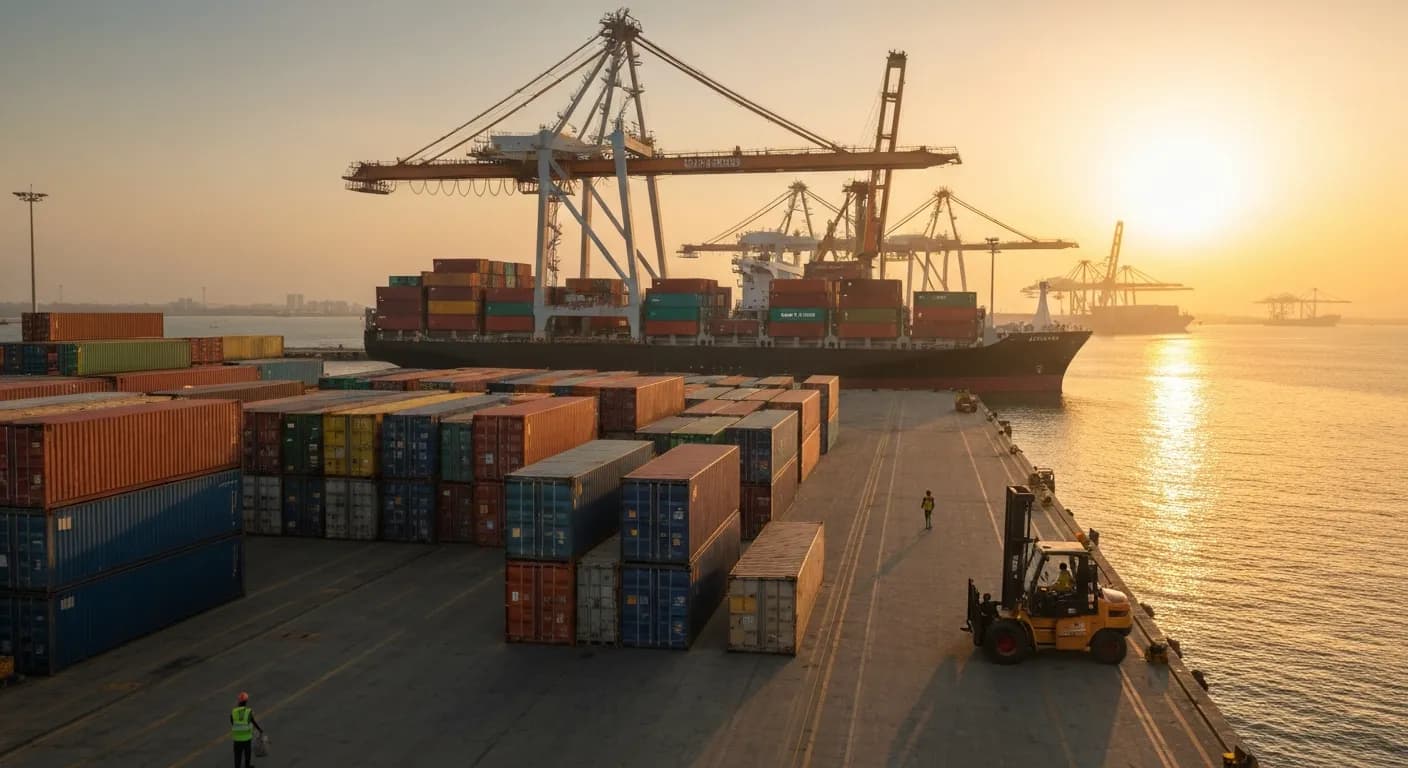
Sub-Saharan Africa's food import bill is forecast to hit $65 billion in 2025 — its third consecutive year of growth, up from $62.8 billion in 2024, according to FAO's latest Food Outlook. For importers, distributors and buyers of dairy and food products across West Africa and the broader continent, that headline figure tells only part of the story. Behind it lies a compounding set of freight and logistics pressures that are reshaping sourcing decisions, eroding margins and demanding more careful supply chain planning than ever before.
The Red Sea Diversion: A Freight Reality That Is Here to Stay

The single most consequential disruption to global ocean freight remains the ongoing avoidance of the Red Sea and Suez Canal. Since late 2023, most major carriers have rerouted vessels around the Cape of Good Hope to avoid Houthi attacks in the region. As of mid-2026, that routing has become the industry default — and market consensus now points to diversions continuing through at least 2027.
The capacity implications are significant. Freightos estimates that Red Sea diversions have absorbed approximately 9% of global container capacity, as carriers must deploy additional vessels to maintain weekly sailing schedules on key lanes. Asia–Europe freight rates remain 25–40% above pre-crisis baselines, and while long-term Far East–Mediterranean contract rates eased to around USD 2,308 per FEU in January 2026 — down roughly 25% from end-2025 peaks — they still reflect a structurally elevated cost environment for any supplier routing product from Asia or the Gulf toward African markets.
For buyers in West Africa who rely on imported dairy staples such as evaporated milk, condensed milk or milk powder, this means the landed cost of goods from origins east of Suez has not meaningfully normalised, and is unlikely to do so in the near term.
Last-Mile and Inland Freight: Where Costs Compound

Ocean freight is only the first cost hurdle. Once containers reach an African port, inland transportation introduces a second, often underappreciated layer of expense. In the East African Community, road freight currently costs approximately $1.80 per kilometre — nearly double the global average of $1.00 — with projections suggesting rates could climb to $2.10/km as fuel costs are passed through the chain (Shippers Council of Eastern Africa).
In Kenya, road transporters announced a 14% rate increase in 2026, and Kenya Railways Corporation introduced a fuel price adjuster on its cargo tariffs, pushing the Mombasa–Nairobi 20ft container rate from $500 to $550. The underlying driver is straightforward: fuel accounts for roughly 55% of road freight operating costs in East Africa, meaning any move in diesel prices flows almost directly into the cost of moving food.
For West African routes, the picture is further complicated by port congestion, customs coordination failures and security incidents at key border crossings. The July 2025 terrorist attack on the Diboli customs post on the Senegal–Mali border illustrated how quickly physical chokepoints can become acute vulnerabilities. Sea freight for a standard 20ft container to Africa ranged between $1,500 and $6,000 in 2025, with Nigeria routes carrying approximately a 10% congestion premium. Fuel surcharges added a further 15–25% on top of base rates, and seasonal demand spikes could push rates up by an additional 20%.
Structural Weaknesses That Amplify Every Shock
These near-term pressures sit on top of deep structural constraints. African food supply chains are, on average, four times longer than those in Europe, and transport costs can account for up to 45% of the final price of some goods (World Bank, May 2025). A striking concentration of infrastructure means that just 10 African ports supply food to 89 million people, while 20 border crossings serve 66 million people across 35 countries — chokepoints that leave the system acutely exposed to any single disruption.
Post-harvest storage losses compound import dependency: an estimated 37% of locally produced food is lost or wasted due to inadequate storage, sustaining demand for imported processed and packaged food products. A World Bank analysis published in May 2025 found that even a 10% improvement in regional trade efficiency could increase food availability by 5% and reduce consumer prices by 3% — underlining how much value is currently being destroyed in the logistics chain.
Currency depreciation adds a final multiplier. Because freight and most commodity contracts are USD-denominated, local currency weakness in key West African markets amplifies every global price shift for the importer paying in naira, cedi or franc.
Takeaway for Buyers and Partners
The cost pressures shaping food and dairy imports into Africa in 2026 are not temporary volatility — they reflect a convergence of geopolitical disruption, infrastructure constraints and macroeconomic headwinds that will persist for the foreseeable future. For importers and distributors, the practical response lies in longer planning horizons, more flexible sourcing arrangements and closer collaboration with suppliers who hold reliable shipping relationships and regional logistics expertise. Monitoring freight benchmarks, building buffer stock where storage allows and understanding the full landed-cost picture — not just the FOB price — will be the disciplines that separate resilient businesses from those caught short.
Sources
- FAO forecasts third straight rise in Sub-Saharan Africa’s food imports to $65 billion
- How Much Does It Cost to Ship to Africa? 2025 Guide
- Africa Freight Logistics Market Size, Share & Growth 2034
- Counting the cost: Why East Africa’s importers will pay more - The EastAfrican
- Sub-Saharan Africa’s food imports set to reach $65 billion in 2025 - Ecofin Agency
- Shipping from China to South Africa in 2026 | Guide
- Africa Weighs Costs and Gains of Global Shipping Reform Push | Dawan Africa | Dawan Africa
- High freight rates strain global supply chains, threaten vulnerable economies | UN Trade and Development (UNCTAD)
This article is market commentary prepared by the Dairy Land Research Team for general information only and does not constitute commercial, financial or trading advice.