
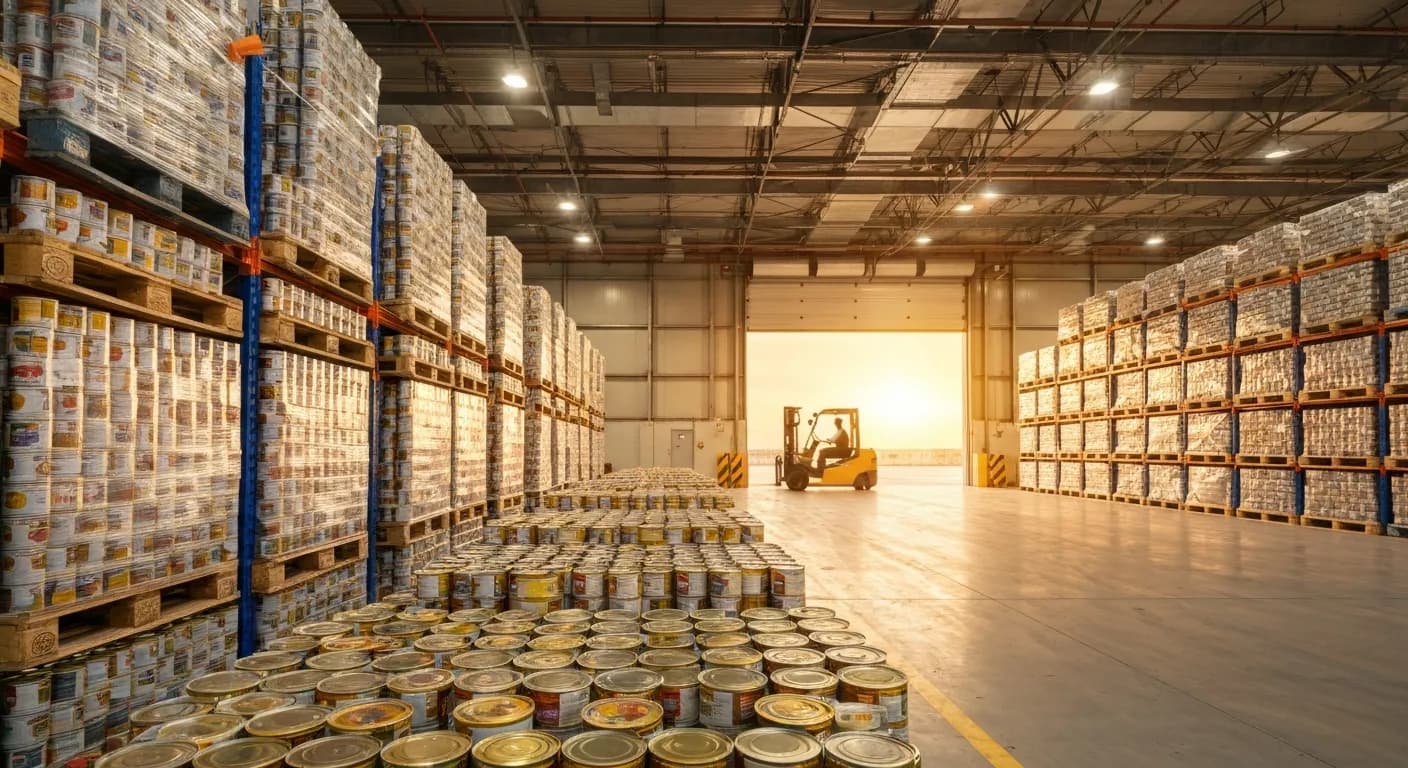
The global evaporated and condensed milk market is growing steadily, valued at USD 7.5 billion in 2024 and forecast to reach USD 11.7 billion by 2034 at a compound annual growth rate of 4.6%. Yet behind that headline trajectory, 2026 presents a more nuanced picture: supply-side relief on dairy commodities is being offset by structural cost pressure in packaging, while demand signals diverge markedly between West Africa and the Middle East.
Dairy Commodity Costs Are Easing — But Not Uniformly

For producers of canned dairy, input costs have shifted considerably in their favour over the past twelve months. Global milk production is growing only marginally in 2026 — forecast at just 0.2% year-over-year, well below the 2.6% increase recorded in 2025 — yet exportable surpluses remain ample, keeping commodity prices suppressed.
The numbers are significant. Fat markets have dropped approximately 40% and whole milk powder is down around 30% compared to prior-year levels. Protein-based dairy commodities — including skim milk powder, cheese and whey — have seen declines of around 15%. Butter and anhydrous milk fat are also lower. The USDA's 2026 All-Milk price projection sits at roughly $19.70 per hundredweight, and Rabobank's Global Dairy Quarterly has flagged that weaker commodity prices are likely to persist through 2026 given ample milk supplies and exportable surpluses.
For buyers and importers, this environment historically translates into more competitive pricing from manufacturers with strong dairy procurement — a meaningful advantage when locking in supply contracts.
Tinplate Packaging: A Structural Cost Headwind

The other side of the ledger tells a different story. Tinplate steel — the primary material for canned food packaging — is caught in the crossfire of US tariff policy. Domestic US tinplate production has declined by roughly 75% since 2018, leaving manufacturers heavily dependent on imports at tariff-inflated prices.
The Consumer Brands Association has estimated that canned food prices could rise 9–15% as a result of US steel tariffs, and major food manufacturers are already quantifying the impact. Conagra's CEO noted on the company's Q4 2025 earnings call that the tariff environment would add approximately 3% to cost of goods sold — equivalent to more than $200 million annually in 2026. Critically, no policy relief on aluminium or tinplate steel tariffs has materialised.
For the broader canned dairy category, this means that even as dairy input costs ease, packaging costs are rising — compressing margins for producers and, ultimately, adding upward pressure to shelf and import prices. Industry voices expect greater price increases on canned goods in 2026 than were seen in 2025.
West Africa: Structurally Attractive, Urbanisation-Driven
Against this cost backdrop, demand fundamentals in West Africa remain compelling. The region is a structurally import-dependent market for evaporated and condensed milk, underpinned by long-established dietary preferences in which these products play a central role — from household tea preparation to foodservice and institutional catering.
Urbanisation is accelerating the trend. Growing urban middle-class populations across the MEA region are expanding consumption of processed and shelf-stable dairy, both at home and through a developing foodservice sector. West Africa is specifically identified in current trade data as a demand hotspot with distinct trade routes and pricing dynamics. For distributors operating in the region, the combination of sustained volume demand and supply-chain complexity makes reliable, competitively priced sourcing a genuine differentiator.
Middle East: Demand Under Near-Term Pressure
The Middle East picture is more cautious in the near term. Ongoing geopolitical tensions in the region are exerting downward pressure on dairy prices and, notably, on purchasing behaviour. Buyers are delaying procurement decisions in anticipation of further price reductions — a pattern that suppresses near-term import volumes even where underlying consumption demand remains present. Distributors and importers operating in this market should factor geopolitical disruption into their inventory planning and contract timing.
Takeaway for Buyers and Distributors
The structural growth case for evaporated and condensed milk — across both West Africa and the Middle East — remains intact over the medium to long term. In the near term, 2026 is a year of margin management: lower dairy commodity costs offer an opportunity to negotiate competitively, but rising packaging costs mean that headline price relief may be partial rather than substantial. West Africa continues to offer the most stable demand runway; Middle East sourcing strategies warrant closer monitoring of the geopolitical environment before committing to volume positions.
Sources
- South Africa's Powdered, Evaporated and Condensed Milk Market Report 2026 - Prices, Size, Forecast, and Companies
- Africa's Powdered, Condensed or Evaporated Milk Market Report 2026 - Prices, Size, Forecast, and Companies
- Dry, Condensed and Evaporated Milk Market’s Evolutionary Trends 2026-2034
- Condensed Or Evaporated Milk Market Size & Share 2025
- Africa's Evaporated and Condensed Milk Market to See Modest Growth with +1.3% CAGR - News and Statistics - IndexBox
- United States Dry Condensed Evaporated Milk Market Outlook 2025-2032
- Africa's Unsweetened Condensed and Evaporated Milk Market Set for Modest Growth to 110K Tons and $183M - News and Statistics - IndexBox
- Global Dairy Markets Face Margin Pressure As Supply Outpaces Demand In Early 2026 | Community | yankton.net
This article is market commentary prepared by the Dairy Land Research Team for general information only and does not constitute commercial, financial or trading advice.