
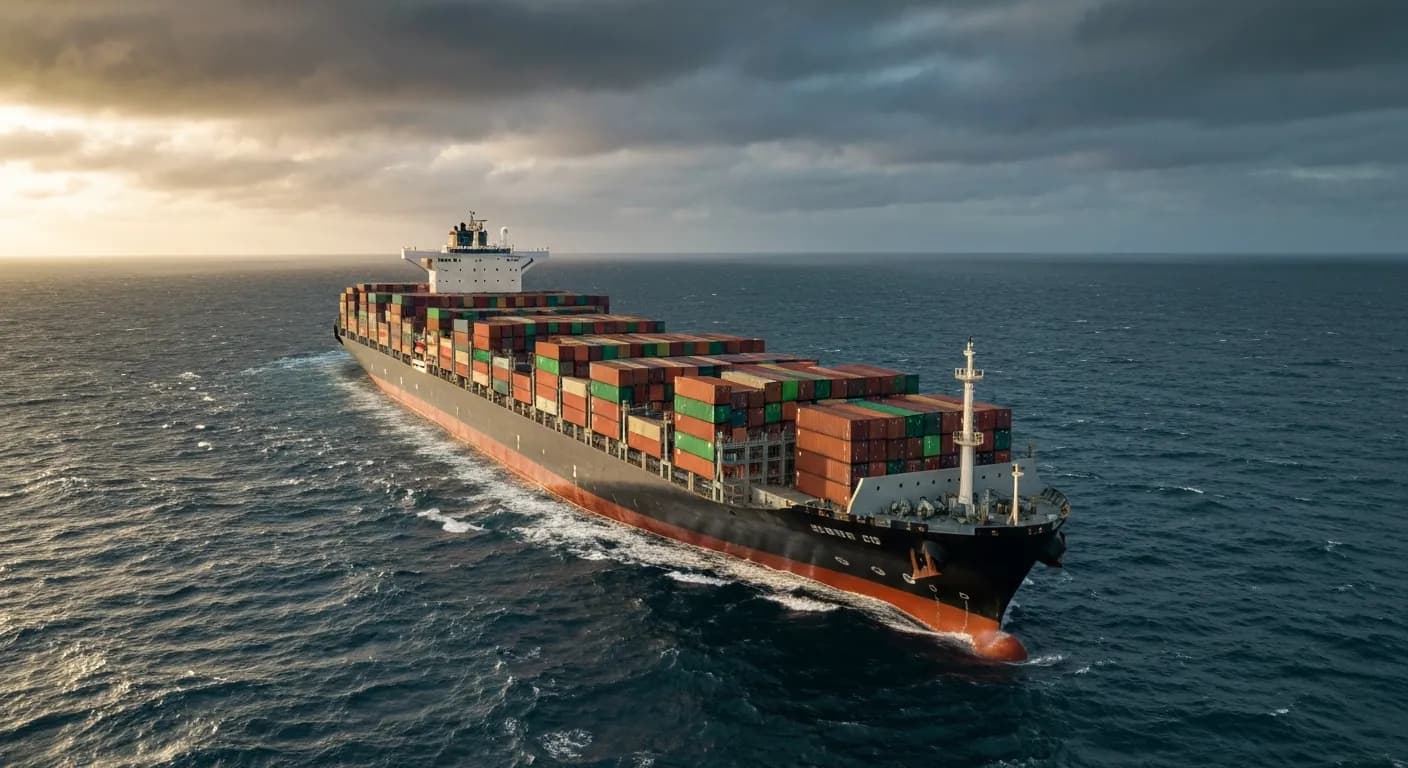
The global shipping corridors that connect Asian production hubs to West African and Middle Eastern markets have not returned to normal — and by most indicators, they are becoming more complex. For importers and distributors of dairy products, canned goods, and food staples, the disruptions that first emerged in late 2023 have now compounded into a multi-layered logistical challenge with direct consequences for lead times, landed costs, and supply planning.
The Red Sea Corridor: Still Largely Closed

The Suez Canal's role as the world's principal east-west shipping artery has been dramatically diminished. According to S&P Global Market Intelligence analysis from February 2026, east-to-west shipments via the canal stood at just 18.7% of pre-disruption levels — a figure that has barely moved from its two-year average and remains well below the roughly 80% share the route commanded before the crisis began.
The Houthis remain a live threat. In late February 2026, following US and Israeli strikes on Iran, they threatened to escalate and resume Red Sea attacks, and on 28 March launched a ballistic missile at Israel. They have also warned that a full closure of the Bab-el-Mandeb strait is possible if the broader regional conflict intensifies or if Gulf Arab states enter the war. S&P Global notes that the risk of vessel attacks in transit remains severe on a one-year outlook.
Carrier behaviour reflects this uncertainty. While some lines, including Maersk, have resumed selective Red Sea transits, others are pulling back. CMA CGM announced that several of its major Asia-Europe services — including FAL1, FAL3, and MEX — which had briefly returned to the Suez Canal in 2025 will revert to routing via the Cape of Good Hope, citing what the carrier described as a "complex and uncertain international context."
A Second Choke Point: The Strait of Hormuz

What has changed materially in 2026 is the addition of a second strategic vulnerability. Escalating tensions around the Strait of Hormuz — through which a significant share of Gulf energy and cargo traffic flows — have introduced new risk directly relevant to UAE-based exporters. As reported by Freightos in May 2026, Iranian attacks on commercial vessels, subsequent US naval responses, and Iranian missile and drone strikes on the UAE itself represent significant escalations since the current ceasefire took effect. Analysts note that US operations in the region are unlikely to fully reopen the strait in their current form, meaning this second chokepoint remains unresolved.
For companies operating out of the UAE, this is no longer a distant disruption to someone else's supply chain. It bears directly on the reliability and cost of outbound export movements.
Freight Rates and Cost Pressures Heading Into H2 2026
The financial impact of rerouting is now well established. With Cape of Good Hope routing the effective industry standard for vessels avoiding the Red Sea, shippers are absorbing transit extensions of 10 to 14 additional days, along with sustained freight premiums of 25 to 35% above pre-crisis baselines, according to DocShipper data from March 2026. Those extra days translate directly into higher fuel burn, larger working capital requirements, and reduced vessel availability across trade lanes.
Spot rate data underscores that pressure is not easing. The Drewry World Container Index climbed to an 18-month high as of 18 June 2026 — the most recent reading available — signalling renewed upward momentum in rates as the industry moves into the second half of the year. Global ocean freight demand has grown approximately 4% year-to-date in 2026, driven by strong Asian export volumes, but effective capacity remains constrained by ongoing Suez detours and port congestion. J.P. Morgan has noted that with 30% of global container trade normally transiting Suez, the cost increases now embedded in supply chains are likely to pass through to imported goods prices with a lag.
For West Africa specifically — a market served via ports including Lagos, Abidjan, and Tema — the Cape rerouting adds meaningful sailing distance and time on top of already lengthened voyages. Asia-to-MENAT (Middle East, North Africa, and Turkey) lanes are also under pressure, with declining effective capacity and reduced schedule reliability compounding the cost challenge.
One structural dynamic worth monitoring is the potential emergence of a two-tier carrier market: a premium tier using the Suez route at elevated war-risk insurance rates, and a standard tier continuing via the Cape. Even if security conditions improve, insurance markets are expected to maintain elevated war-risk premiums on Red Sea transits for an extended period.
Planning Implications for Buyers and Distributors
The environment heading into H2 2026 calls for deliberate supply chain adjustments rather than a return to pre-2024 planning assumptions. Extended lead times need to be built into replenishment cycles. The carrier fragmentation now evident — with some lines back in the Red Sea and others reverting to the Cape — means transit time variability is higher than it was even six months ago, making forward inventory positioning more important than ever.
Freight cost budgets should reflect sustained premiums rather than a near-term normalisation. And the Hormuz dimension adds a layer of UAE-origin export risk that was not part of the calculation a year ago. For any importer or distributor sourcing dairy, canned goods, or food commodities from the region, building flexibility and buffer into procurement plans is not a precaution — it is a structural necessity for the remainder of 2026.
Sources
- Red Sea Crisis Update: Route Alternatives & Cost Impacts
- The Impacts of the Red Sea Shipping Crisis | J.P. Morgan
- The Red Sea Crisis: Impacts on global shipping and the case ...
- The Red Sea Shipping Crisis (2024–2025): Houthi Attacks and Global Trade Disruption | Atlas Institute for International Affairs
- Shipping Delays & Freight Cost Increases 2025 | Freightos
- Red Sea Shipping Crisis 2026: Rates, Reroute, Transit | Suaid Global
- Red Sea Crisis: How Shipping Disruptions Impact Global and Regional Trade
- How The Red Sea Shipping Crisis Affects Global Trade
This article is market commentary prepared by the Dairy Land Research Team for general information only and does not constitute commercial, financial or trading advice.