
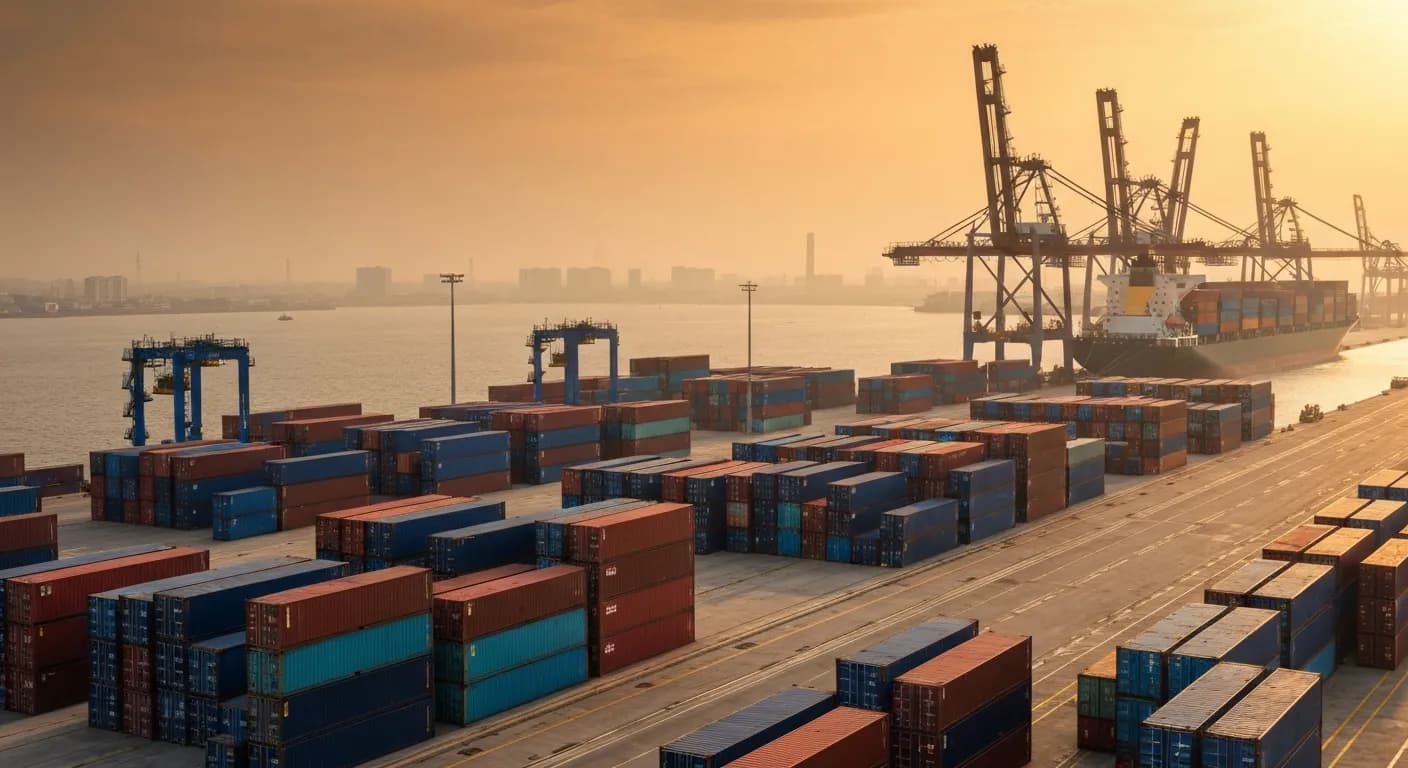
The operating environment for food and dairy exporters in 2026 is defined less by a single shock than by the compounding pressure of several simultaneous forces: sustained freight volatility, stricter cold chain compliance requirements, escalating food waste costs, and a widening set of supplier risks. For exporters serving markets across the UAE and West Africa, understanding how these forces interact is the starting point for building a resilient H2 2026 operation.
Freight Volatility Is Structural, Not Cyclical

The Red Sea security situation has fundamentally reshaped container shipping economics. With Red Sea transits down approximately 90%, Cape of Good Hope routing has become the industry standard rather than a contingency measure. The practical consequences are significant: transit times increase by ten to fourteen days per voyage, and freight premiums of 25–35% above pre-disruption benchmarks have persisted. Asia-to-Mediterranean rates on a 40-foot container reached around $4,200 in January 2026, up from roughly $2,300 in October 2025.
The important nuance here is that the underlying market dynamic has shifted. Overcapacity and fleet growth — not tight vessel supply — are now the primary drivers of rate movement. This means rates can soften during calm periods and spike sharply when a new disruption event occurs. As Freightos noted at the end of 2025, "planning for change — rather than stability — remains the most realistic approach." For buyers and importers on the UAE–West Africa corridor, this requires procurement strategies that build in freight cost ranges rather than point estimates.
Cold Chain Compliance Is Raising the Bar

The global cold chain logistics market is forecast to grow from approximately $436 billion in 2025 to over $1.3 trillion by 2034, reflecting both commercial demand and regulatory pressure. In 2026, stricter global standards for food logistics have come into effect, with a specific focus on electronic trackability, structured data capture and provable thermal control throughout the cold chain.
For ambient and shelf-stable dairy products — evaporated milk, condensed milk, milk powder — temperature management during storage and transit is directly linked to shelf-life outcomes. The economic cost of food waste across global supply chains is forecast to reach $540 billion in 2026, making it the single most costly challenge cited across cold chain surveys. Real-time IoT monitoring of temperature during transport, combined with specialised packaging materials and temperature-controlled warehousing, is no longer optional best practice — it is fast becoming a compliance baseline that importers and their regulators expect exporters to demonstrate.
Buffer Stock Strategy and the Working Capital Trade-Off
The ten-to-fourteen day transit extension caused by Cape routing creates a direct inventory management problem. To maintain service levels to West African markets without gaps, exporters must carry more pipeline inventory — product that is in transit or awaiting clearance at any given moment. This ties up working capital and, depending on shelf-life horizons, can compress the usable life of product by the time it reaches the end distributor.
The practical response involves two parallel actions. First, building structured buffer stock at regional distribution points closer to destination markets reduces dependency on any single shipment cycle. Second, advanced analytics and AI-driven demand forecasting — identified as a priority investment for the dairy sector in 2026 — help calibrate how much buffer stock is genuinely needed versus how much simply represents excess working capital. Exporters who are shifting cargo across multiple lanes to diversify market exposure are already applying a version of this logic at the network level.
Supplier Risk Requires a Dual-Sourcing Discipline
The four leading categories of supply chain risk in 2026 — economic, environmental, political and ethical — are all live on UAE–West Africa trade lanes. Supplier insolvency, export restrictions, climate-related crop disruption and sourcing standards are not hypothetical concerns; they are recurring operational realities. Supply chain cyber and physical attacks nearly doubled between 2024 and 2025 at a combined global cost of $53.2 billion, adding a further layer of exposure for logistics networks that have digitalised their operations.
Industry best practice in 2026 centres on dual-sourcing contracts with key raw material suppliers, so that a single supplier failure does not halt production. Combined with regional distribution hub strategies that reduce single-facility dependency, this approach builds the kind of operational redundancy that protects service continuity when individual nodes in the chain are disrupted.
Closing Takeaway
The combination of persistent freight premiums, tightening cold chain compliance and a broader supplier risk landscape makes three themes operationally urgent for food and dairy exporters in H2 2026: shelf-life management tied to accurate transit-time planning, buffer stock sizing that balances service levels against working capital, and dual-sourcing discipline that removes single points of failure from the raw material base. Exporters and their distribution partners who address all three together are best placed to maintain reliable supply to their markets through a period of continued uncertainty.
Sources
- Modernizing Global Food Trade: Digitization & Cold Chain Resilience
- Trends already redefining cold chain logistics in 2026
- Cold Chain Logistics in 2026: Trends, Costs & Solutions
- Food Waste Ranked Most Costly Challenge in Global Cold Chain | Food Logistics
- Cold Chain Logistics Trends That Are Changing the Industry - iGPS
- Cold Chain Market Report: Trends, Growth & Future Outlook
- Food Cold Chain Market Size, Share, Outlook 2025 – 2030
- The Future of Cold Chain Logistics: Challenges and Opportunities Facing Global Cold Chain Logistics from Vaccines to Fresh Foods | HKIA Cargo Intelligent Portal
This article is market commentary prepared by the Dairy Land Research Team for general information only and does not constitute commercial, financial or trading advice.