
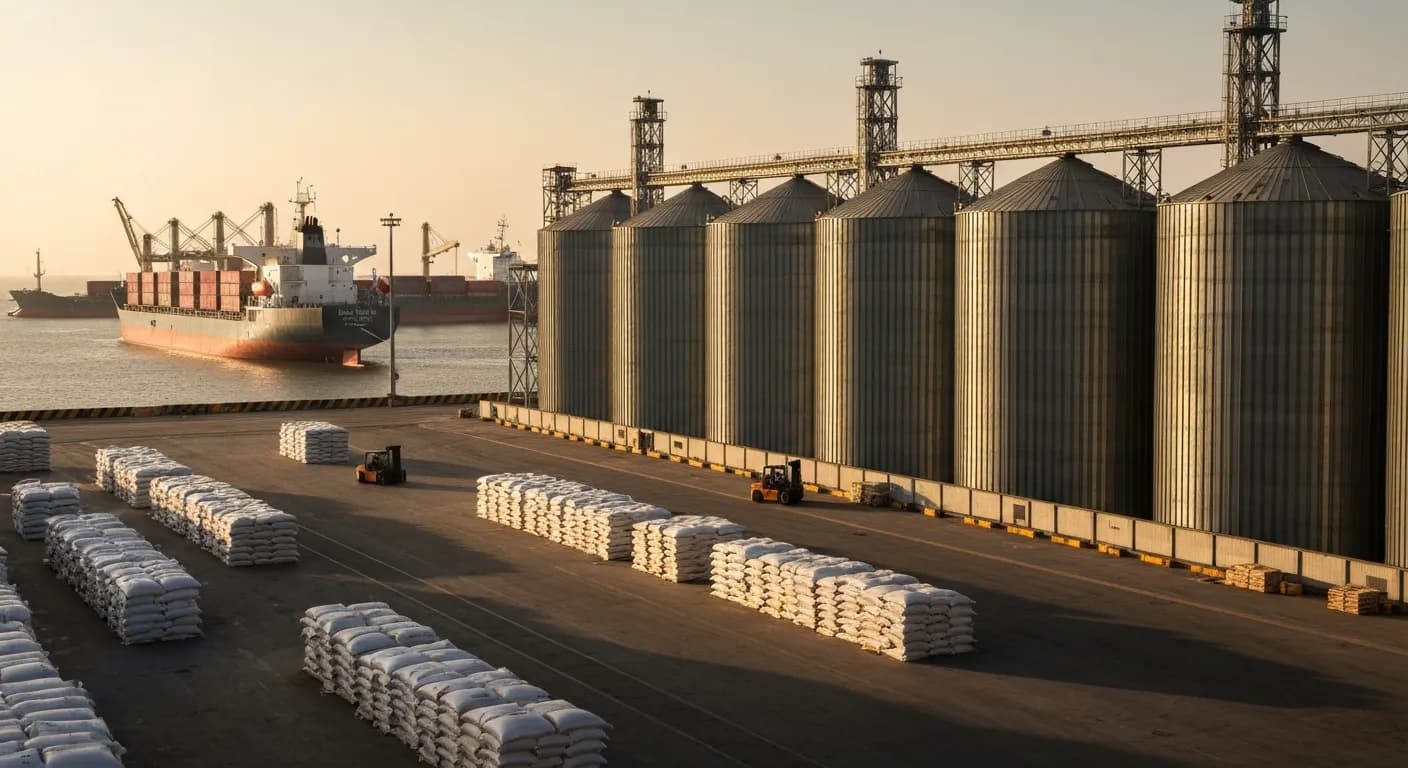
The global grains and pulses landscape has shifted meaningfully since the start of 2026. After a record cereal harvest of 3,043 million tonnes in 2025/26, the FAO projects world cereal production to fall roughly 2% in 2026/27 to 2,982 million tonnes. That reversal — driven primarily by deteriorating wheat crop conditions — is already being felt in commodity prices and freight markets. For food distributors and importers serving West Africa and the Gulf, the implications are material and worth planning for now.
Wheat: A Sharp Correction in Supply and Price

Wheat is where supply stress is most acute. The FAO Cereal Price Index stood at 110.2 points in June 2026, still 2.7% above June 2025 levels despite a modest month-on-month dip. World wheat prices rose 3.4% month-on-month in May 2026 and were 7.8% higher year-on-year, reflecting crop deterioration across key exporting nations.
The United States presents the starkest picture. Winter wheat crop conditions are described by USDA analysts as among the least favourable in decades. The USDA's May 2026 WASDE report projects U.S. winter wheat production for 2026/27 at 1,048 million bushels — down 25% from last year — with U.S. exports projected to fall by 135 million bushels on reduced exportable supplies. The projected U.S. farm price of $6.50 per bushel represents a $1.50 increase from the prior year. Hard Red Winter wheat prices in May 2026 were already 28% above May 2025 levels.
Global wheat trade is projected to contract to 211.7 million tonnes in 2026/27, a decline of 12 million tonnes, as reduced import demand from North Africa and the Middle East — where domestic harvests have improved — partially offsets tighter export availability. Russia remains the dominant exporter, ahead of the EU, Canada, Australia and the US. While some supply may nominally free up for other importers, the underlying price direction is clearly upward, compounded by elevated fuel and fertiliser costs.
For Gulf and West African buyers: Wheat-dependent supply chains — including flour, bakery inputs and blended food products — face sustained cost pressure through H2 2026. Forward procurement and supplier diversification deserve attention now.
Rice: El Niño Risk and Record African Demand

Rice markets are tightening from a different angle. Rice futures reached $13.34 per hundredweight in late June 2026, the highest since June 2025, having gained over 6% in four weeks and more than 5% over twelve months. The FAO All-Rice Price Index rose 2.7% month-on-month in May, underpinned by El Niño-related supply concerns and higher crude oil prices feeding into production and logistics costs.
USDA data projects U.S. rice production for 2026/27 at 175.2 million hundredweight, down 15% on lower harvested area, with total rice supplies down approximately 10%. Global rice ending stocks are projected at 192.7 million tonnes, a decline of 3.6 million tonnes from the prior year.
Critically for West African-focused distributors, the USDA has highlighted Nigeria among several countries where rice consumption is expected to reach record levels. This structural demand growth, coinciding with contracting global stocks, creates a particularly tight supply-demand dynamic. China's expanding exports of competitively priced medium-grain rice offer some relief at the lower end of the market, but premium and long-grain varieties remain under upward price pressure.
Pulses: A Mixed Picture With a Near-Term Buying Window
The pulse complex offers a more nuanced outlook. Lentil markets are currently characterised by what traders describe as a surplus overhang from Canada — the world's dominant lentil exporter — which is keeping prices relatively stable and, in some segments, soft. For buyers, this represents a near-term procurement opportunity before market conditions tighten.
Chickpeas present a dual-market dynamic. Global production for 2024/25 is projected at 17.1 million tonnes, up 2% year-on-year, led by Australia. Kabuli chickpeas command retail premiums in North Africa and the Gulf, while desi varieties move in bulk to South Asia and parts of Africa. One variable to monitor closely is India's tariff policy on pulse imports: the continuation of its low-duty import regime beyond March 2026 has been flagged, but Australian exporters remain cautious pending formal confirmation, creating some uncertainty in export flows.
Freight Costs Add a Layer of Risk
Beyond commodity prices, the shipping environment is adding to landed costs. Tensions around the Strait of Hormuz are influencing routing decisions and carrier availability in the Gulf. MSC has made Emergency War Surcharges mandatory on East Africa and Indian Ocean cargoes, directly affecting the economics of food distribution along routes critical to West African supply chains. These surcharges compound the commodity price increases already working through the system.
Takeaway for Distributors and Importers
Heading into H2 2026, wheat and rice represent the most acute cost and availability risks for food businesses serving the Gulf and West Africa. Lentils offer a relative buying opportunity given current surplus conditions. On all commodities, freight costs deserve to be factored into landed-cost calculations more carefully than in recent years. Distributors who act on procurement decisions in the coming weeks, rather than waiting for further price clarity, are better positioned to protect margins as the season progresses.
Sources
- Rice Price Update | Markets and Trade | Food and Agriculture Organization of the United Nations
- ISSN: 1554-9089 World Agricultural Supply and Demand Estimates Office of the
- Rice - Price - Chart - Historical Data - News
- Rice Outlook: January 2026 - Economic Research Service
- 2026 Rice Market Outlook
- Rice Outlook: January 2026 | Economic Research Service
- Global rice prices to stay under pressure in 2026 amid exporter competition - Milling Middle East & Africa Magazine - No.1 Grains Industry Magazine & Website for Africa & the Middle East
- Rice Market Outlook 2026
This article is market commentary prepared by the Dairy Land Research Team for general information only and does not constitute commercial, financial or trading advice.