
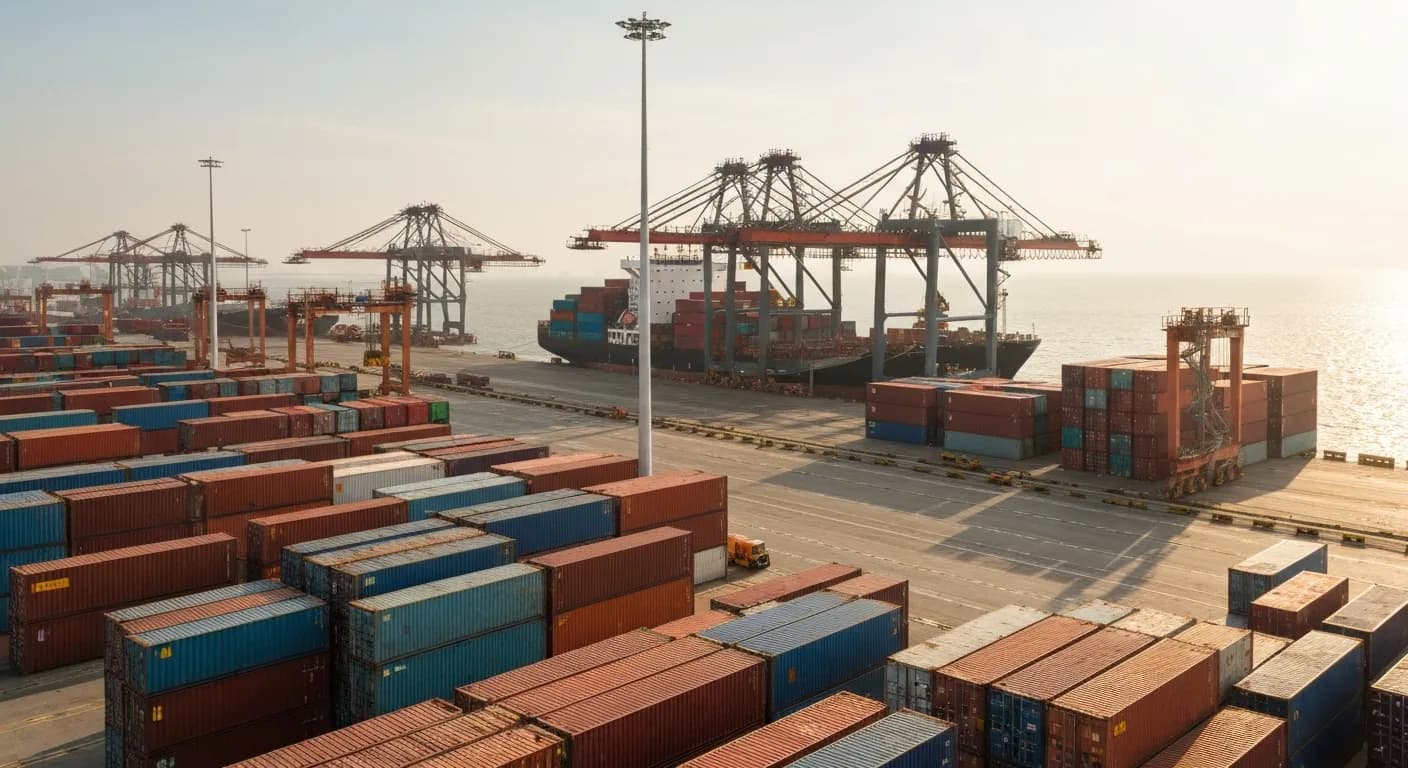
Container shipping markets have entered one of their most turbulent periods since the post-pandemic freight spike. For food importers, distributors and buyers operating across the UAE–West Africa corridor, the combination of geopolitical disruption, re-routing, and peak-season demand is reshaping cost structures in ways that require careful attention now.
The Rate Environment: Where Things Stand

The Drewry World Container Index (WCI) reached $4,639 per 40ft container in the week of 9 July 2026 — the highest reading since September 2024 and up 61% year-on-year. A separate benchmark, the Freightos Baltic Index, registered $3,714 per 40ft container as of early July. Both indices reflect a market that has tightened considerably since early 2025.
These headline figures do not capture the full picture for Gulf and Africa-bound cargo. Emergency surcharges of $1,800–$3,800 per container remain in place for shipments to or from UAE, Saudi Arabia, Qatar, Kuwait, Bahrain, Oman, and Iraq. On top of this, HMM introduced a Peak Season Surcharge of $3,000 per 40ft container effective 15 July 2026, and Drewry expects further rate increases in the weeks ahead. Bunker Adjustment Factor surcharges — reflecting low-sulphur fuel costs of $450–$600 per metric ton — add a further $200–$600 per container depending on route length, with the longer Cape of Good Hope diversions pushing costs toward the upper end.
The Hormuz Disruption and Its Lasting Effects

The root cause of today's elevated rates is the military escalation involving US, Israeli, and Iranian forces that began in late February 2026. The immediate consequences were severe: containerised imports into the Middle East collapsed 64% year-on-year in March 2026, and exports fell 62%. Jebel Ali Port — the largest port in the Middle East and the primary gateway for UAE trade — was briefly suspended by DP World after debris from an aerial interception caused a fire. Major carriers including Maersk, MSC, CMA CGM, and Hapag-Lloyd suspended or severely restricted Gulf bookings.
The Safeen Prestige, a 16,000-TEU containership, was struck by projectiles in the Strait of Hormuz on 4 March, killing workers onboard — an event that crystallised how acute the security risk had become. Spot rates from China to Jeddah, which was acting as a land-bridge gateway into the broader Middle East, surged 85% between late February and late March.
An interim US-Iran agreement has since facilitated partial reopening of the Strait, and vessel traffic is gradually recovering along designated transit routes. However, major carriers have not returned to Hormuz routing. The Cape of Good Hope diversion remains the standard path, adding 10–14 extra days per voyage and an estimated $300,000–$600,000 in additional fuel and operating costs per ship. War-risk insurance across the Gulf and Red Sea has also been reclassified, with many insurers unwilling to issue coverage at any price — a constraint that further inflates all-in freight costs.
Implications for the UAE–West Africa Food Trade
For food product flows between Dubai and West Africa, the consequences are direct and measurable. Dubai-to-East Africa sea freight rates are currently running at approximately $2,200–$3,500 per container, compared with $1,200–$1,800 before the crisis — an increase of around 80%. Gulf freight rates more broadly remain 40–60% above pre-crisis levels on most GCC routes. By contrast, road freight within the Gulf is up only 20–25%, making intra-GCC land movement relatively more attractive for short-haul distribution.
For food importers planning procurement, Q3 2026 is the most expensive booking window in recent memory. Peak-season demand from global retailers is coinciding with constrained capacity and elevated surcharges. Shippers are also increasingly diversifying across multiple carriers rather than concentrating volumes with one or two partners — a structural shift that offers more flexibility but requires greater operational coordination.
What the Outlook Suggests
Industry analysts offer a cautiously optimistic normalisation timeline. If mine-clearance operations in the Gulf progress without further diplomatic setbacks, war-risk premiums could begin to ease in Q3 2026, with rates potentially declining 10–15% from current peaks. The first carriers are expected to resume Hormuz routing in Q4 2026, which could bring rates down 20–30% from their highs. A fuller return toward pre-crisis freight economics is not projected until Q3 2027 at the earliest — and even then, analysts anticipate rates settling at roughly 120–130% of pre-crisis baselines rather than a complete reset.
For buyers and importers across the UAE and West Africa, the near-term message is clear: landed costs will remain elevated through at least the end of 2026, and contract terms, pricing assumptions, and inventory strategies all need to reflect this reality. Building in longer lead times, reviewing freight contract structures, and monitoring carrier announcements closely will be essential tools for managing margin through this period.
Sources
- Free Container Shipping Cost Calculator | Freightos
- USA to West Africa Shipping: Mode, Costs & Documentation
- Drewry - Service Expertise - World Container Index - 09 Jul
- How Much Does It Cost to Ship to Africa? 2025 Guide
- Ocean Freight Rates 2026: Prices, Surcharges & Savings
- International Container Shipping Rates Chart: April 2026
- Ocean Freight Rates [May 2026]: $1,200–$7,200 | Suaid Global
- Ocean Freight Rates & Shipping Guide | Freightos
This article is market commentary prepared by the Dairy Land Research Team for general information only and does not constitute commercial, financial or trading advice.